

The Camel Is Dead. Long Live the Camel._
In a facility outside Riyadh, something walks that has never walked before.

The Camel Is Dead. Long Live the Camel._
In a facility outside Riyadh, something walks that has never walked before. It has four legs, a hump, and moves with an eerie familiar gait across the sand. It hasn't eaten in three weeks. It doesn't need to.
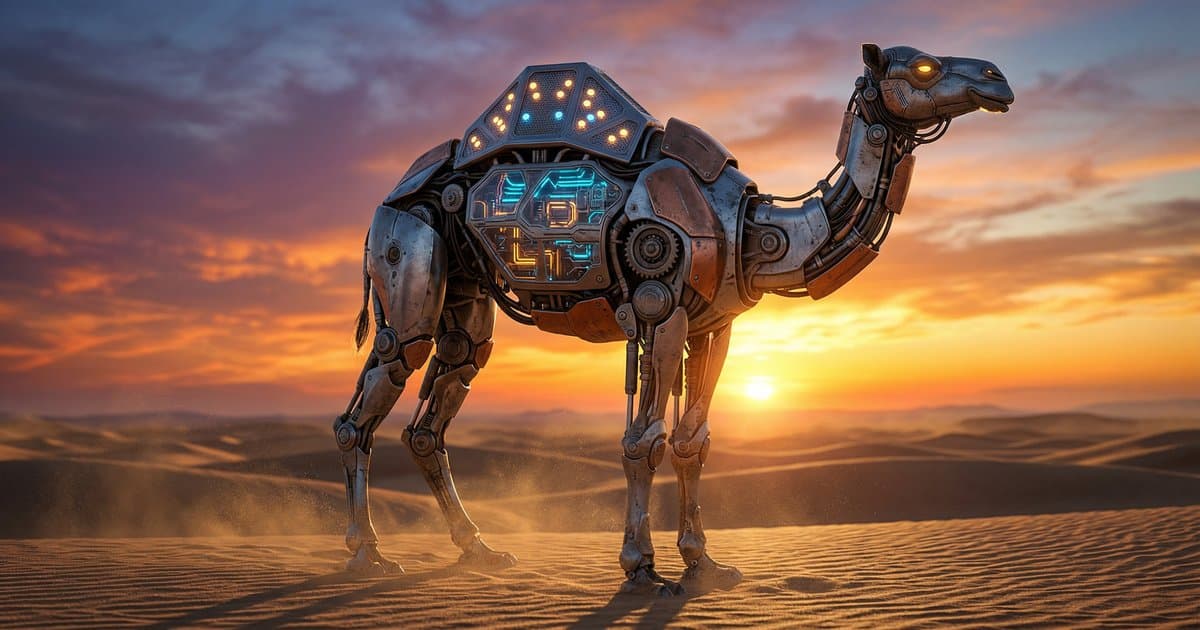
Meet CamelBot 1.0 — titanium frame, solar skin stretched across its dorsal surface, LIDAR arrays where the eyes would be, and at its center, rising like a promise or a punchline, a thermal-insulated modular hump housing enough battery capacity for 72 hours of continuous desert operation.
Its inventor, Khalid Al-Rashidi, is a Saudi venture capitalist who spent years funding renewable energy projects before a crossing of the Rub' al Khali — the Empty Quarter, one of the largest continuous sand deserts on Earth — gave him a different idea entirely. "I looked at my camel," he says, "and thought: this shape is already perfect. Nature did the engineering. I just had to do the rest."
He is not wrong. And that's where this story gets interesting.
Eight Thousand Years of Prior Art
Before we get to the robot, let's talk about what it's imitating — because the dromedary camel is, without exaggeration, one of the most consequential pieces of biological engineering in human history.
The oldest large-scale animal carvings ever discovered are of camels. They sit in Saudi Arabia's al-Jouf province at a site researchers have simply called "The Camel Site," and they date to somewhere between 7,000 and 8,000 years ago — older than the Pyramids of Giza, older than Stonehenge. When those carvings were made, the Arabian Peninsula was a grassy plain dotted with lakes. The camels hadn't even been domesticated yet. Whoever made them was already paying their respects.
Domestication came later — roughly 3,000 years ago — and when it did, it reshaped the ancient world. For millennia, dromedaries were the primary burden animals connecting Arabia, North Africa, the Near East, and Central Asia. A Nottingham University study analyzing 1,083 living dromedaries from 21 countries, combined with ancient DNA from specimens going back 5,000 years, found that the great trade routes had permanently blurred the genetic boundaries between regional populations. The camel didn't just carry civilization along the Silk Road. It mixed civilizations together at the molecular level.
Today, Saudi Arabia's camel population contributes more than SAR 2 billion — approximately $533 million — annually to the economy through food, textiles, and tourism. In 2024, the Saudi Ministry of Culture declared the Year of the Camel. The Kingdom is now planning to issue formal passports to its millions of camels for herd management purposes. The animal that made Arabia navigable is being enrolled in a database.
Against that backdrop, Al-Rashidi's robot is either the logical endpoint or an extremely good joke. Possibly both.
The Hump Problem, Solved Twice
Here is what most people get wrong about camels: the hump doesn't store water. It stores fat. The water conservation happens everywhere else:
- Extraordinary nasal passages that recapture moisture from exhaled air
- A wide thermal tolerance, allowing body temperature to swing across a range that would be dangerous for most mammals, reducing the need to sweat
- A physiology so efficient that a dehydrated camel can lose up to 25% of its body weight in water and survive
The hump is an energy storage organ. It is, functionally, a battery.
When Al-Rashidi says he solved "the hump problem twice," he means this literally. CamelBot's hump is a thermally insulated battery pack designed to stay cool in 50°C heat — managing thermal mass rather than fighting it with active cooling, which is exactly what the biological camel does by letting its temperature rise and fall with the desert day. The engineering insight isn't clever. It's obvious, once you know what you're looking at.
"Everyone laughed at the hump," Al-Rashidi says. "Now they ask how big we can make it."
Bigger, it turns out, is the point. Extended-range humps can be swapped in the field for longer expeditions, like a battery pack on a job site. The bigger the mission, the bigger the hump. "We made range a physical thing you can see," he says. "You look at the camel, you know exactly how far it's going."
Bedouins already knew this. They have been reading a camel's condition from the firmness of its hump for centuries. A well-fed camel carries a taut, upright hump. A depleted one droops. Al-Rashidi did not invent this interface. He rendered it in titanium.
What Saudi Arabia Is Actually Building
The satirical premise here is CamelBot. The real story is arguably stranger.
Saudi Arabia's CamelX initiative — operating explicitly under the Vision 2030 economic diversification framework — is treating the dromedary as a biotech platform. Not a metaphor for a biotech platform. An actual one. Researchers are investigating camelid nanobodies: a class of single-domain antibodies, a third the size of conventional human antibodies, more thermally stable, and capable of accessing molecular targets that standard antibodies cannot reach. They are already of serious commercial interest to pharmaceutical companies globally. The camel's unusual immune architecture, evolved over millions of years in extreme conditions, is being reverse-engineered into drug candidates.
KACST (the King Abdulaziz City for Science and Technology) has sequenced the full Camelus dromedarius genome. KAUST is running AI-equipped drone programs to monitor herd migration, training machine learning models on aerial footage and discovering that camel movement patterns are non-random — coordinated, even, with elder camels appearing to lead herd-wide decisions about grazing range.
Note: The drones are kept above 120 meters because camels, it turns out, are sensitive to the sound.
The camel is not being replaced. It is being read. Its genome, its antibody architecture, its thermal regulation logic, its foot geometry, its navigational behavior — all of it is being encoded into new products, new research programs, new companies. The most commercially significant "CamelBot" may never walk anywhere. It may be a nanobody platform whose shape owes a debt to millions of years of desert immunology.
Al-Rashidi's joke — "Nature did the engineering. I just had to do the rest" — is, word for word, what the Saudi biotech establishment is currently doing. That's what makes it funny. That's what makes it true.
The Thing the Robot Cannot Do
Desert veterans are not fully convinced by CamelBot. A real camel smells water from miles away. It reads weather in ways researchers are still documenting. It navigates socially, with elder animals encoding route knowledge that gets transmitted across generations. When a Bedouin logistics operator hears that CamelBot has LIDAR and GPS, the response is measured.
"It's extraordinary. But it has never been truly lost. So we don't yet know if it can truly find its way."
This is the most honest thing anyone says about AI navigation systems, and it applies far beyond the desert. GPS and LIDAR know where they are. They know this because they were told. A camel knows where the water is because somewhere in its ancestors' history, the ones that were wrong about it died. That's a different kind of knowledge, and it does not compress into a dataset easily.
The KAUST drone research found that camel migration patterns were identifiable and non-random — but also that the animals returned to their herders by sunset, every time, in ways the researchers were still working to fully explain. The machine learning model could track the behavior. It could not yet explain it.
There is also the question of what a robot camel does not do that a biological one does. Dromedary camels are increasingly studied as ecosystem engineers — regulating plant growth, improving soil health, potentially contributing to carbon storage in landscapes that are otherwise losing ground to desertification. The robot, by definition, contributes none of this. It crosses the desert. It does not belong to it.
The Beginning of a Legacy
Al-Rashidi, for his part, is not troubled by the comparison. "The camel made Arabia," he says. "Now Arabia will make the camel's successor. This is not the end of an animal. It is the beginning of a legacy."
It is a good line. It is also, like most good lines, not entirely right and not entirely wrong. The biological camel isn't going anywhere — Saudi Arabia is registering each of its millions of them in a government database and studying their genomes and filming their migrations from aircraft. The country is more invested in the real camel than it has been in generations, and that investment is scientific as much as cultural.
What's actually happening is something more interesting than replacement: an ancient technology is being fully understood for the first time. Eight thousand years after someone in al-Jouf carved the image of a camel into rock for reasons we can only guess at, researchers are sequencing its genome, mapping its antibody architecture, and training AI models on the patterns of its movement. The carving was an act of attention. So is the genomics.
CamelBot is a thought experiment made of titanium. But the thought it experiments with is the right one: that the desert already solved, through deep time and brutal selection, problems that engineers are still working on:
- Thermal management
- Energy storage
- Navigation without infrastructure
- Weight distribution on unstable ground
The camel didn't survive 7,000 years of human attention by being fragile. It will probably survive being turned into a robot, too.
Related Posts_

The AI Gap Nobody Talks About: You've Seen the Demo, Now What?
You've had the moment. You're watching a demo, or you've just typed something into ChatGPT on a whim, and the response comes back and you think — okay, that's genuinely remarkable.

When AI Designs Experiments Humans Can't Explain
There's a quiet crisis brewing in physics labs, and it has nothing to do with broken equipment or funding cuts.

AI Personality Is a Feature, a Bug, and a Mirror
If you've ever felt like ChatGPT was being weirdly cheerful, or noticed that Claude has a different vibe than Gemini, you're not imagining things.